
Tattle Tails Tuesday - Toxins
"The smallest feline is a masterpiece"
Leonardo da Vinci
Tattle Tails
My Three Cats Bury's weekly blog
(click for HTA's guide to toxic plants)
Hi cat fans!
Jen here for the weekly blog post from My Three Cats - Bury, premium cat sitter.
One of the joys of being a veterinary nurse is of course the kitties I get to nurse, but sometimes those kitties are very poorly as people may not be aware of what could potentially cause harm to their beloved kitty & inquisitive kitties will often smell something they just HAVE to taste............like my Phoebe.......
Spring has sprung, summer is loading (we hope!) and that means more blooms, more pollen, different things that may make a cat poorly.
I've not added a long list here as there are actually quite a few plants that can cause tummy upsets, drooling, and other clinical signs, but I'm going to start with the most dangerous. Below the listed plants are links to resources from the fabulous Cats Protection who have a wealth of information available to owners. In the title you can also click on the link that will take you to the Horticultural Trades Association site which has a comprehensive list of harmful plants to humans and companion animals.
⚠️LILIES⚠️
Every part of a lily is toxic to cats. Yep, that's every, single, part. Before I entered the wonderful world of veterinary care I thought it was only the pollen and although that is often considered the most toxic part ingestion of, or licking of, any part of a lily can cause illness, and even prove fatal.
Please be aware that having the pollen removed from lilies does not make them safe to have in a household with cats.
Should you see your cat suddenly have yellowing fur and have a very distinct flowery smell, and lilies are in the house, it's important to wash off as much as you possibly can to stop further ingestion. This is due to even small amounts causing clinical signs if ingested. Call your vet as soon as you possibly can if you suspect ingestion of any part of a lily, even if you can't be 100% sure, due to the issues it can cause your cat. If ingestion has been within 2-4 hours it may be possible to induce vomiting (if the cat isn't already doing so) to remove further toxin from the stomach.
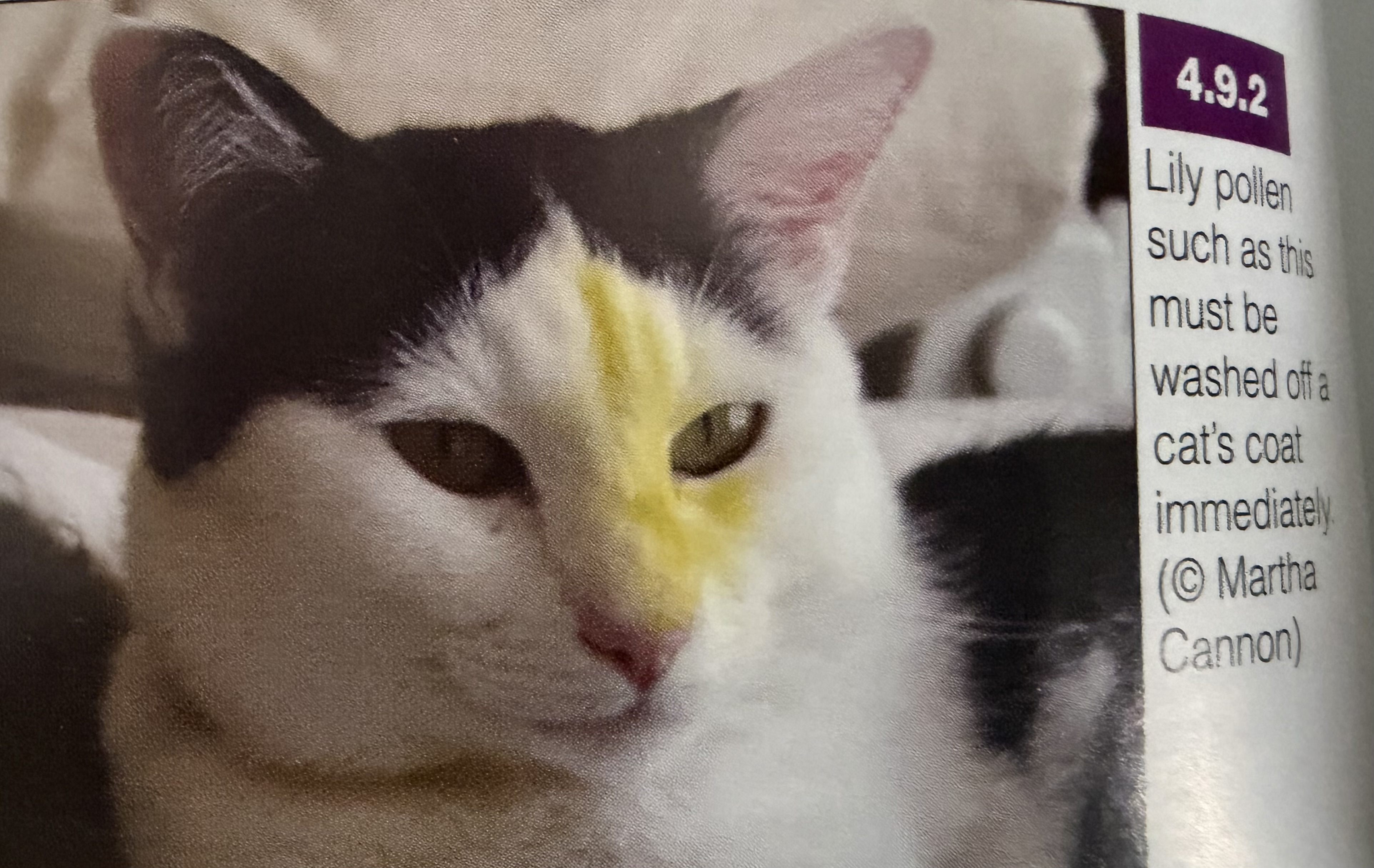
Clinical signs to look out for are:
Early onset - Drooling, Lethargy, Vomiting, Diarrhoea
Within 12 hours - Anorexia/Hyporexia, continued vomiting and uncommon though seen in severe cases - wobbling (ataxia), facial and paw swelling (oedema), seizure activity (twitchiness, convulsions), and head pressing (Cannon, 2018)
The progression of clinical signs for lily toxicity can be rapid and cause irreversible kidney damage. While calla lilies are less toxic to cats than other varieties care and caution still needs to be taken, and any ingestion needs to be swiftly addressed due to crystals they contain.
❗DAFFODILS❗
We know cats love to paw and dig at dirt, often to toilet, however if they happen to chance upon a bulb of these lovely flowers the crystals they contain can be hazardous to cats, causing gastrointestinal upsets and potentially wider clinical issues.
⚠️CYCAD (Sago Palm, Fern Palm)⚠️
An indoor plant highly toxic to cats, and dogs. Humans can also be affected if ingesting seeds or have irritation from contact with these plants.
Further plants categorised as dangerous (per Cats Protection lists):
Crocus Autumn (saffron, Colchicum autumnale, crocus sativus, Liliaceae)
Day lily (Hemerocallis)
Foxglove (digitalis) - if cut and put in a vase the water will become toxic also
Fritillary (Snakeshead)
Gloriosa superba (glory lily, flame lily, climbing lily)
Juniper (Savin, sabina) berries
Lily (Lilium, Hemerocallis) ALL LILIES!
Lily of the Valley (Convallaria majalis)
Nerium oleander (dogbane family)
Ornithogalum umbellatum (Star of Bethlehem) - another Christmas plant to be mindful of is the lovely Poinsettia.
Water hemlock
Yew (Taxus)
Tansy (ragwort) / Common ragwort (Senecio jacobaea)
Docks (rumex crispus)
Oxalis (wood sorrel, shamrock)
Many of the above plants will have similar clinical signs, presenting at varied times depending on amount eaten and whether any existing conditions exist.
Many cats won't eat something that tastes unpleasant, and luckily some of these plants are reported to be bitter tasting, but if you're anything like me this list is more than I was aware of when not in the veterinary world and actually lists some of my favourites in the caution lists! The links below will take you to the pages giving a link to the pdf.
Available at: https://www.cats.org.uk/help-and-advice/home-and-environment/dangerous-plants
As always, if there is a topic you'd like me to discuss please reach out and let me know, or to ask about availability and bookings. You can reach us on 01613077598, e-mail me at [email protected] or contact us via Facebook, Instagram, TikTok, or pop an enquiry through on our contact form.
Thank you for reading, and hope to be chatting with you soon.
Jen x
(plus Chester, Phoebe, and Mickey - my 3 kitties - it's co-incidence, or meant to be!)
Cannon, M. (2018). Toxins - common feline poisonings. In: Harvey, A., Tasker, S. (Ed).BSAVA Manual of Feline Medicine. Gloucester: BSAVA. p.138.Many cats won't eat something that tastes unpleasant, and luckily some of these plants are rep
